
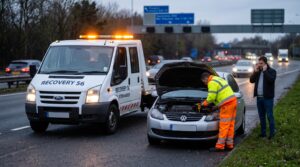
There is nothing quite as frustrating as turning your ignition key or pressing the start button, only to be met with complete silence, a rapid clicking sound, or an engine that churns endlessly without firing up.
Whether you are stranded in a driveway in Walsall, stuck in a carpark in West Bromwich, or halted along the West Midlands road network, knowing how to diagnose a starting fault can help you decide whether a quick jump-start will work or if professional recovery is needed.
In this troubleshooting guide, we cover the most common reasons a car won’t start, how to identify the problem, and what steps to take next.
Quick Diagnostic Checklist: What Is Your Car Doing?
Before calling roadside assistance, pay attention to what happens when you attempt to start the engine:
- Scenario A: Rapid clicking sound when turning the key
- Likely Cause: Low battery voltage or corroded battery terminals.
- Scenario B: Total silence, no dashboard lights or radio
- Likely Cause: Completely flat 12V battery, blown main fuse, or dead key fob battery.
- Scenario C: Engine turns over (cranks) fast, but won’t start or catch
- Likely Cause: Fuel supply problem, spark plug/ignition failure, or immobiliser key fault.
- Scenario D: Engine won’t start even with jumper cables connected
- Likely Cause: Faulty alternator, seized starter motor, or blown jump-start fuse.
4 Common Reasons Your Car Won’t Start
- Flat or Failing 12V Battery
The single most frequent cause of starting trouble across the UK is a depleted battery. Cold weather, short stop-and-start journeys, or leaving headlights on overnight drain battery power. If the battery is older than 3 to 5 years, it may no longer hold enough charge to turn the starter motor.
- Starter Motor Solenoid Failure
The starter motor is an electric motor responsible for turning the engine over to begin the combustion process. If you hear a single sharp “clack” when turning the key but the engine doesn’t crank, the starter motor solenoid or electrical wiring may have failed.
- Faulty Alternator
While the battery starts the car, the alternator recharges the battery while you drive. If your alternator fails, your car will run solely on battery reserve until it completely dies. If your headlights dimmed or battery warning lights appeared on the dashboard while driving prior to shutting off, the alternator is likely responsible.
- Immobiliser & Key Fob Issues
Modern vehicles use electronic transponders inside the key fob to verify identity before allowing ignition. A dead key fob battery or a desynced security system will allow the dash to light up while actively preventing fuel delivery or starter motor engagement.
How to Safely Jump-Start a Modern Vehicle
If you suspect a flat battery, a jump-start can get you back on the road. However, modern vehicle electronics (ECUs) are sensitive to power surges, so follow these safety steps:
- Position the booster vehicle close enough for cables to reach, keeping engines off.
- Connect the RED positive cable to the positive (+ terminal) of the flat battery.
- Connect the other end of the RED positive cable to the positive (+ terminal) of the booster battery.
- Connect the BLACK negative cable to the negative (- terminal) of the booster battery.
- Connect the other end of the BLACK negative cable to an unpainted metal earthing point on the engine block of the dead car (not the dead battery terminal).
- Start the booster vehicle’s engine and let it run for 2–3 minutes before attempting to start the dead car.
Note: If the engine turns over but refuses to start after 2–3 short attempts, stop cranking. Repeated attempts can overheat the starter motor or flood the engine with fuel.
What to Do If Your Car Still Won’t Start
When jumper cables fail to start the vehicle, forcing the ignition can cause secondary electrical damage. At this point, the safest option is to arrange flatbed vehicle recovery to transport your car safely to a local garage or home driveway.
Need Emergency Roadside Recovery in the West Midlands?
If your car won’t start in Walsall, West Bromwich, Birmingham, or along the M6/M5 corridor, Recovery 56 is ready to help 24/7.
- Rapid Roadside Assistance: On-the-spot jump-starts and battery boosts.
- Professional Flatbed Towing: Safe transport for non-running or locked-up vehicles.
- Upfront Pricing: Clear local rates with no hidden subscription fees.
- 📞 Call Recovery 56 directly on 07394 440056 for fast 24/7 roadside recovery!


